Introduction
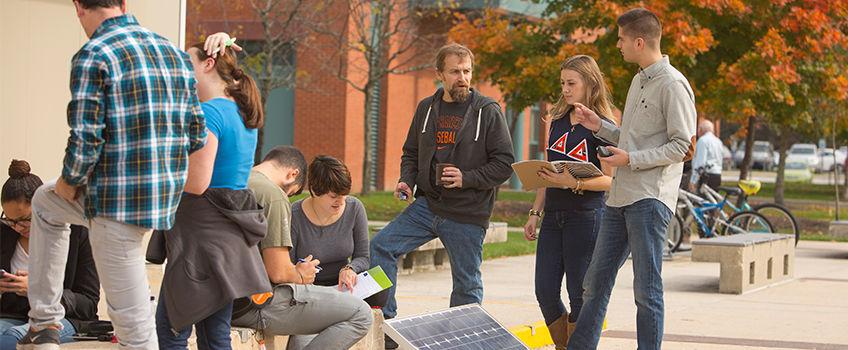
Energy Studies is an interdisciplinary program. It is designed to educate students in the multifaceted problems associated with energy usage in our society and to pose methods for possible solutions to problems. Energy prices and supplies have become, and will remain for the foreseeable future, a major concern for homeowners, business people and industry. The majority of residential and commercial buildings in the United States will have their energy efficiency drastically upgraded during the next decade. The geothermal heat pump project at Stockton is serving as a national model for such upgrades. Also, the campus serves as a model for fuel cells, photovoltaic solar electric, and advanced aquifer thermal energy storage systems. There will be a demand for “house doctors” and “building doctors” that can diagnose energy inefficiencies and prescribe remedies. There will also be a need for “energy planning” to design community plans and incentive programs. As homeowners and users of energy resources, students will be faced with their own personal need to conserve energy. The energy problem is complex and involves scientific, technological, economical, and political components. Hence, the Energy Certificate program involves faculty from several programs within the College.
Program Organization
Two different curricular plans are offered, each leading to a certificate that will be awarded at graduation: 1) the Physical Science Energy Certificate program, and 2) the Environmental Science Energy Certificate program. Each of these programs is interdisciplinary in nature. The Physical Science Energy Certificate program is generally designed for majors in physics, chemistry, geology, and mathematics. It emphasizes the application of physical laws to energy-related issues and energy technology. The Environmental Science Energy Certificate program is generally designed for majors in environmental studies, biology, and marine science. It emphasizes the relationship of energy use, energy resources, and energy technology to the environment and society. Any Stockton student, regardless of major, who can meet the requirements detailed below will be fully eligible for certification.
Graduation Requirements
The following course requirements must be met for certification:
1) The Physical Science Energy Certificate
Program
PHYS 2220/25 Physics I with lab
PHYS 2230/35 Physics II with lab
MATH 2215 Calculus I
MATH 2216 Calculus II
CHEM 2110 Chemistry I -
General Principles
with lab
Two of the following four (those marked with an asterisk are offered as independent study):
PHYS 3443 Energy Planning
PHYS 3444 Energy Management (or GNM 3321 Energy Management)
PHYS Energy Physics*
PHYS Alternate Energy Sources*
One energy-related elective, and an energy-related senior project or internship, and one introductory economics course from the following:
ENVL 3454 Environmental Economics
ECON 1400 Introduction to Microeconomics
ECON 1200 Introduction to Macroeconomics
The elective can be an independent study in an energy area or a regular program or General Studies course.
2) The Environmental Science
Energy Certificate
PHYS 2110/15* Physics for Life
2120/25* Sciences I, II with labs
CHEM 2110/15 Chemistry I -
General Principles
with lab
* PHYS 2220 and 2230 with labs, can replace the above.
Two of the following four (those marked with an asterisk are offered as independent study):
ENVL 3443 Energy Planning
ENVL 3444 Energy Management (or GNM 3321 Energy Management)
ENVL Energy Physics*
ENVL Alternate Energy Sources*
One energy-related elective, and an energy-related senior project or internship, and one introductory economics course from the following:
ENVL 3454 Environmental Economics
ECON 1400 Introduction to Microeconomics
ECON 1200 Introduction to Macroeconomics
The elective can be an independent study in an energy area or a regular program or General Studies course. After completing these requirements, the student will receive the energy certificate following graduation.
Career Opportunities
The Energy Certificate program will be of direct use to students pursuing careers in newly emerging fields, such as energy planning, energy conservation in buildings, alternative energy sources (e.g., wind and solar power) and other fields.
The Energy Certificate program is also designed to give nonspecialists an enhanced appreciation of how energy issues affect their own disciplines (e.g., economics, environmental studies, marine science) and even their own immediate lives. Thus, it can provide nonspecialists with an understanding of energy conservation in their homes.
Special Opportunities
Information about the Program
Coordinator of Energy Certificate Program
The Richard Stockton College of New Jersey
PO Box 195
Pomona, NJ 08240-0195
Phone: (609) 652-4546
Dean of Enrollment Management
The Richard Stockton College of New Jersey
PO Box 195
Pomona, NJ 08240-0195
Phone: (609) 652-4261
| © 2010 Richard Stockton College The Richard Stockton College of NJ, PO Box 195, Pomona, NJ 08240 609-652-1776 |